B.R. Gavai: Parliament Should Address SC/ST Act Misuse
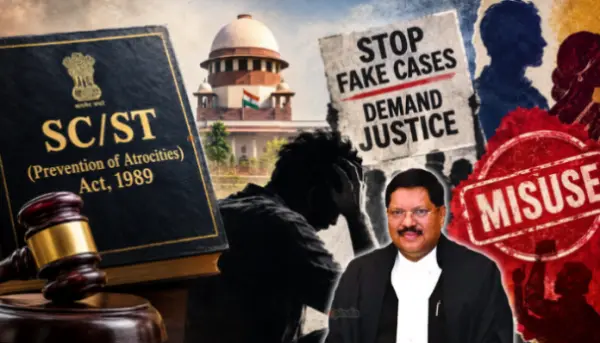
- 1Former CJI B.R. Gavai said the SC/ST (Prevention of Atrocities) Act serves an important purpose and should not be scrapped because of instances of misuse.
- 2Gavai said Parliament, rather than the judiciary, is the appropriate institution to amend the law if additional safeguards are considered necessary.
- 3He suggested that lawmakers could consider stricter penalties for deliberately filing false complaints, while existing judicial safeguards can continue to operate in individual cases.


Get Krihaa News App on Your Mobile
Real-time breaking news alerts, political analysis, and movie reviews on Android.
Core News and Key Facts
The debate over the SC/ST (Prevention of Atrocities) Act is increasingly shifting from a simple question of whether the law should exist to a more specific question: how can its protections remain strong while preventing deliberate misuse? Former Chief Justice of India B.R. Gavai has placed the emphasis on that second question.
Gavai said the law serves an important social purpose because members of Scheduled Castes and Scheduled Tribes have historically faced discrimination and atrocities. At the same time, he acknowledged that instances of misuse can occur. He described such misuse as rare and said it should not become a reason to scrap the legislation.
His position is significant because he has previously dealt with the legal safeguards surrounding the Act as a Supreme Court judge. The broader legal debate has repeatedly involved balancing protection for vulnerable communities with procedural safeguards for people accused under the statute.
Context and Official Statements
Gavai said that if experience shows a need for stronger safeguards, Parliament should consider amending the legislation. He stressed that changing the law is primarily a legislative function and suggested that stricter penalties for deliberately false complaints could be considered.
His comments come against a background in which the Supreme Court has itself recognised that the Act cannot be invoked without satisfying its essential legal requirements. In a 2025 judgment, a bench headed by Gavai held that proceedings under the Act could be quashed where the allegations did not establish the necessary caste-based element.
The Court has also continued to apply judicial safeguards in individual cases. In May 2026, for example, the Supreme Court quashed an SC/ST Act case where the alleged caste abuse at a private residence was not shown to have occurred within public view, a statutory requirement for the relevant offences.
Krihaa Analysis
The most important part of Gavai’s remarks is the institutional distinction he draws. He is not arguing that the protection provided by the SC/ST Act should disappear; he is saying that if Parliament believes additional safeguards are necessary, the legislature has the power to write them into the law.
That distinction matters because the debate can otherwise become unnecessarily binary: either defend every provision of the Act or portray the entire law as vulnerable to misuse. The practical legal question is narrower. How should the system respond when a genuine atrocity is alleged, while also dealing with a complaint that is demonstrably false or malicious?
There is also a difference between a complaint ending in acquittal and a complaint being deliberately fabricated. An unsuccessful prosecution does not, by itself, establish that the original complaint was false. Any stronger penalty for false complaints would therefore need carefully defined legal thresholds so that genuine victims are not discouraged from approaching the authorities.
For ordinary citizens, the real test is whether both protections can operate simultaneously: a victim should have meaningful access to the law, while an accused should have access to fair judicial scrutiny. Gavai’s comments put that balance back in the hands of Parliament rather than framing it as a question for the courts to rewrite the statute.
Related Topics
Comments (0)
Join the conversation
Sign in to comment & receive news alerts. Unsubscribe anytime.
Suggested Stories in General

Xi Jinping to Trump: China and US Should Be Partners
Xi Jinping has urged China and the US to act as partners rather than rivals ahead of talks with Donald Trump on trade, AI, Taiwan and Iran.

Trump-Xi Summit: Trade Truce Extended as Talks Begin
Donald Trump gave Xi Jinping a rare airport welcome as their Washington summit began, while the US and China agreed to extend their trade truce into January 2027.

Charminar: Plaster Falls Again, Tourists Escape Danger
Charminar in Hyderabad faced another safety scare after decorative plaster fell from the first floor at night, raising fresh questions over maintenance and tourist safety.
Published by
Krihaa News — Hyderabad, Telangana
Krihaa News is committed to accurate, independent reporting. Read our editorial guidelines and corrections policy.